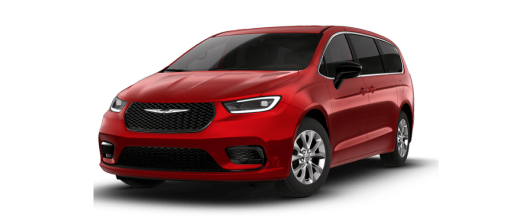
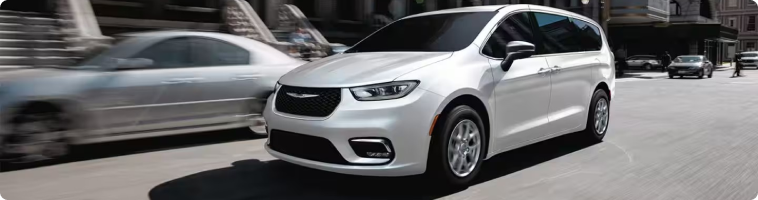
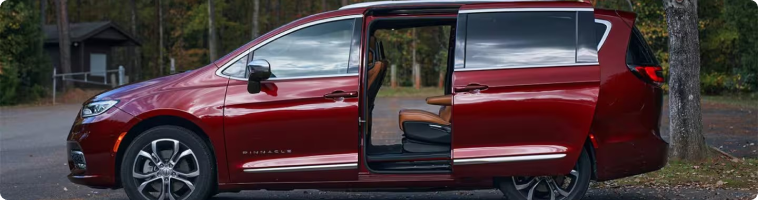
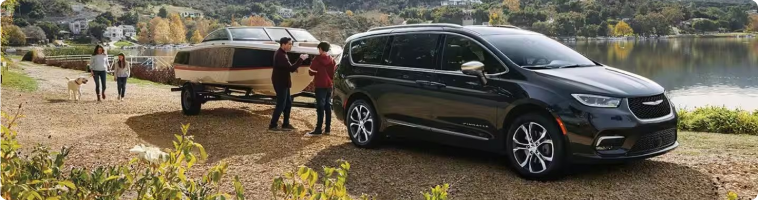
Only one of these two minivans can be ordered with a second driven axle. The 2026 Chrysler Pacifica is offered with
all-wheel drive. The 2026 Honda Odyssey is front-wheel drive on every trim, and all-wheel drive is not offered on it. For a
family in Western Pennsylvania that keeps a van through a decade of Februaries, that is usually where the decision lands.
At a Glance
Powertrain and Drive
Size and Maneuvering
Seating and Cargo
Comfort and Technology
Driver Assistance
Safety
Warranty
Choose Which
FAQ
The Odyssey answers back on seat count, and it wins that one outright. It seats 8 in all four of its trims, with no
7-seat version. The Pacifica seats 7 standard. Its 8-passenger layout belongs to the Select alone, front-wheel drive
only, so 8 seats and all-wheel drive cannot live on the same Pacifica.
Almost everything else lands close. Fuel economy is identical front-wheel drive to front-wheel drive, and the two engines
make the same torque. The two vans are within about an inch of each other in length and height, and cargo volume is
effectively matched behind all three rows. So it comes down to two questions: do you need the extra driven axle, and do
you need the eighth seat?
At a Glance
Anyone shopping these two wants the same handful of things: sliding doors, a third row an adult can sit in, and a cargo
hold that takes whatever the week piles up. Both vans deliver all three. The table below is where they stop agreeing.
Dimension
2026 Chrysler Pacifica
2026 Honda Odyssey
Drive systems offered
Front-wheel drive, with all-wheel drive offered on the Limited
Front-wheel drive across the range; all-wheel drive is not offered
Engine
3.6L Pentastar V-6, 287 hp, 262 lb-ft
3.5L V6, 280 hp, 262 lb-ft
Fuel economy, front-wheel drive
19 city / 28 highway / 22 combined
19 city / 28 highway / 22 combined
Seating
7 standard; an 8-passenger layout is optional on the Select and offered only with front-wheel drive, never with
all-wheel drive
8 in every trim; no 7-seat version offered
Third-row headroom
38.7 in
38.3 in
Shoulder room, first / second / third row
63.8 / 63.0 / 61.2 in
63.1 / 61.6 / 60.0 in
Cargo behind third / second / first row
32.3 / 87.5 / 140.5 cu ft
32.8 / 86.6 / 140.7 cu ft
Roadside assistance
5 years / 60,000 miles
Through the 3-year / 36,000-mile basic term
Best-Fit Buyer Type
The family that wants a driven front and rear axle for valley winters and can live with 7 seats
The family that needs 8 seats in every configuration and more legroom in the back two rows
Read across it and a pattern shows up. The Pacifica's edges are in what it can be built with and how wide it is. The
Odyssey's are in how many people it carries and how much room their legs get.
Powertrain and Drive
Both vans use a V6 and an automatic transmission, and they make identical torque. The drivetrain choice is what
separates them.
Powertrain
2026 Chrysler Pacifica
2026 Honda Odyssey
Engine
3.6L Pentastar V-6
3.5L V6
Horsepower
287 hp at 6,400 rpm
280 hp at 6,000 rpm
Torque
262 lb-ft at 4,000 rpm
262 lb-ft at 4,700 rpm
Transmission
TorqueFlite 9-speed automatic
10-speed automatic with Shift-By-Wire and paddle shifters
Drive systems
Front-wheel drive; all-wheel drive offered on the Limited
Front-wheel drive, all four trims
Fuel economy, front-wheel drive
19 / 28 / 22
19 / 28 / 22
Fuel tank
19 gal
19.5 gal
Fuel
Regular, 87 octane
Regular unleaded
The 7 horsepower between them is not something you will feel with the van loaded and the school run ahead of you. The
torque figures are the same number, though the Pacifica reaches its peak 700 rpm earlier, and the Odyssey's tank holds
half a gallon more on the same 22 combined rating. What does matter is that the Pacifica can send power to the rear
wheels and the Odyssey cannot, on any trim, at any price.
All-wheel drive on the Pacifica is a Limited configuration rather than a trim of its own, and the rear axle takes
something back nearly everywhere it touches the van. The table below sets the Pacifica against itself, front-wheel
drive against all-wheel drive, so what that axle costs sits in one place.
Pacifica, front-wheel drive against all-wheel drive
Front-wheel drive
All-wheel drive
Fuel economy
19 / 28 / 22
17 / 25 / 20
Final drive ratio
3.25
3.73
Curb weight
4,521 lb
4,883 lb
Gross vehicle weight rating
6,055 lb
6,300 lb
Height
69.9 in
70.7 in
Ground clearance
5.1 in
5.4 in
Track, front and rear
68.3 in
68.8 in
Turning circle, curb to curb
39.7 ft
40.2 ft
8-passenger layout
Optional on Select
Not available
Adding the rear axle costs 2 mpg combined, puts 362 lb on the scales, re-gears the final drive from 3.25 to 3.73,
raises the van 0.8 in and widens the turning circle by half a foot. It also closes the door on the 8-passenger layout.
Those are the terms. Whether they are worth it depends on how your worst 10 mornings of the year go.
Towing is close enough to call even, and neither van can tow its rating without equipment added.
Towing
2026 Chrysler Pacifica
2026 Honda Odyssey
Maximum rating
3,600 lb
3,500 lb
Equipment required
The factory towing equipment fitted
Honda's towing equipment and hitch ball fitted, with trailer brakes in use
Where it is offered
The Limited and the Pinnacle
All four trims
That 100 lb is not a reason to pick one van over the other. Two other things are. The Pacifica cannot be equipped to
tow on every trim, so a buyer who tows should settle that question before landing on the Select. And Honda recommends
premium unleaded when the Odyssey is towing.
Size and Maneuvering
Parked next to each other, these two are the same van. Length and height land within about an inch, and they turn in
the same circle.
Measured front-wheel drive to front-wheel drive
2026 Chrysler Pacifica
2026 Honda Odyssey
Overall length
204.3 in
205.2 in
Width, body only
79.6 in
78.5 in
Height
69.9 in
69.6 in
Wheelbase
121.6 in
118.1 in
Turning circle, curb to curb
39.7 ft
39.64 ft
Curb weight, entry configuration
4,521 lb
4,526 lb
Length, height and curb weight are effectively identical, and the turning circles differ by less than a tenth of a
foot. Neither van is easier to thread through a school pickup line or back into a garage than the other.
The two figures that do separate them: the Pacifica is 1.1 in wider across the body, and it carries 3.5 in more
wheelbase. Neither number changes how the van parks or where it fits. The extra width is the one you notice once you
are inside.
Seating and Cargo
This is the section where the Odyssey wins, and it wins on the number families count first. Every Odyssey seats 8. No
Pacifica seats 8 unless it is a Select with the optional layout, which rules out all-wheel drive.
The constraint that catches people at the order sheet: a Pacifica cannot be had with 8 seats and all-wheel drive. The
8-passenger 2/3/3 layout is a Select option offered only with front-wheel drive. If your family needs the eighth belt
and you also want the rear axle, the Pacifica cannot do both, and the Odyssey seats 8 as standard on every trim it
sells.
Trim by trim, the seat counts land like this.
Trim
Seats standard
Optional seat count
Pacifica Select
7, in a 2/2/3 layout
8, in a 2/3/3 layout, front-wheel drive only
Pacifica Limited
7, in a 2/2/3 layout
None
Pacifica Pinnacle
7, with second-row captain's chairs
None
Honda Odyssey, every trim
8
No 7-seat version offered
Once everyone is buckled in, the room splits row by row.
Measurement
2026 Chrysler Pacifica
2026 Honda Odyssey
First-row legroom
41.1 in
40.9 in
Second-row legroom
39.0 in
40.9 in
Third-row legroom
36.5 in
38.1 in
First-row shoulder room
63.8 in
63.1 in
Second-row shoulder room
63.0 in
61.6 in
Third-row shoulder room
61.2 in
60.0 in
First-row hip room
59.0 in
58.6 in
Second-row hip room
64.8 in
64.8 in
Third-row hip room
49.5 in
48.4 in
The Odyssey gives the second row 1.9 in more legroom and the third row 1.6 in more, which is the difference between a
teenager sitting behind a tall driver and a teenager complaining about it. The Pacifica is the wider van in all three
rows, by 0.7 in up front, 1.4 in in the middle and 1.2 in in the back. It also has 1.1 in more hip room in the third
row. Three across is where that width gets noticed. Hip room in the middle row is the one interior measurement that
comes out level, at 64.8 in on both.
Headroom needs its own table, because the Pacifica's changes with the roof.
Headroom
Pacifica Select, no sunroof
Pacifica Limited and Pinnacle, dual-pane sunroof
Honda Odyssey
First row
40.1 in
38.4 in
38.7 in
Second row
39.6 in
38.0 in
39.2 in
Third row
38.7 in
38.7 in
38.3 in
Set against the Pacifica trims that carry the dual-pane sunroof, the Odyssey has 0.3 in more headroom up front and 1.2
in more in the second row. A Select without the sunroof has the tallest front and middle rows of anything here, at 40.1
in and 39.6 in, so the glass roof on a Limited or a Pinnacle is worth sitting under before you order it. The third row
is the Pacifica's by 0.4 in, and that figure holds whether or not the van has the dual-pane sunroof.
Cargo volume is a wash, in all three of the ways a family actually loads a van.
Cargo volume
2026 Chrysler Pacifica
2026 Honda Odyssey
Behind the third row
32.3 cu ft
32.8 cu ft
Behind the second row
87.5 cu ft
86.6 cu ft
Behind the first row
140.5 cu ft
140.7 cu ft
Behind the third row the Odyssey holds 0.5 cu ft more; behind the second row the Pacifica holds 0.9 cu ft more; behind
the first row they are 0.2 cu ft apart. Nobody should pick a minivan on those margins. No grocery run will ever find
the difference.
What does differ is how the seats get out of the way, and that is worth trying with your hands rather than reading
about.
Seat mechanism
2026 Chrysler Pacifica
2026 Honda Odyssey
Third row
Stow 'n Go bench that folds into the floor, on every trim; the Pinnacle folds it by power
One-Motion 60/40 split Magic Seat, standard on all four trims
Second row
The Select adds Stow 'n Go bucket seats that drop into the floor the same way; the Pinnacle has captain's chairs
Magic Slide seats with armrests, moving side to side and forward for walk-in access to the back, with a
multi-function center seat that makes the middle row a three-place bench
Two answers to the same problem. Chrysler's puts the seats under the floor. Honda's slides them out of the path. Work
both of them yourself in the parking lot before you decide, because that is the part of either van you will touch the
most.
Comfort and Technology
Most of this list is a tie, because both makers load a minivan heavily as standard. The rows that are not ties sit at
the two ends of each range: what the entry trim gives you, and what the top trim gives you.
Feature
2026 Chrysler Pacifica
2026 Honda Odyssey
Touchscreen
Uconnect 5 with a 10.1-inch screen, standard from the Select
9-inch touchscreen, standard on all four trims
Driver information display
7-inch configurable cluster, standard on all
7-inch display, standard on all four
Wireless Apple CarPlay and Android Auto
Standard from the Select
Standard on all four trims
Heated front seats
Standard on all
Standard on all four
Heated steering wheel
Standard on every trim
Elite only
Ventilated front seats
Standard from the Limited, 2 trims of 3
Elite only, 1 trim of 4
Automatic climate control
Three-zone, standard on all, with clean-air filtration
Tri-zone, standard on all four, with second-row controls
Remote start
Standard on all
Standard on all four
Power sliding doors
Standard from the Select
Standard on all four
Audio, entry trim
Select: 6 speakers
EX-L: 160-watt system, 7 speakers with a subwoofer
Audio, top trim
Pinnacle: Harman Kardon, 19 speakers with a 10-inch subwoofer
Elite: 500-watt system, 11 speakers with a subwoofer and Multi-Zone Audio
Sound is the clean split. The Odyssey starts better, with a subwoofer and an extra speaker on its entry trim, and the
Pacifica finishes higher, with 19 speakers at the top of the range against 11. The heated steering wheel is the row
worth marking in a valley winter: a Pacifica has one on the Select, the Limited and the Pinnacle alike, while an
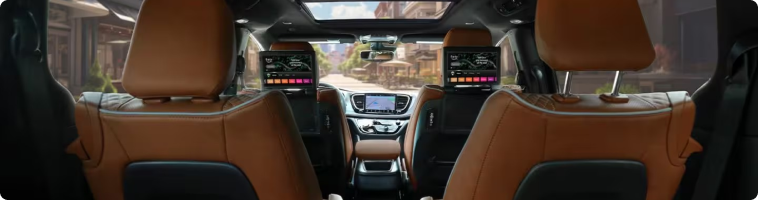
Odyssey buyer reaches it on the Elite. Interior materials climb on both sides, from the Pacifica's Caprice leatherette
through Nappa leather at the top, and from leather-trimmed seating on the Odyssey EX-L to perforated leather with
piping on the Elite.
Driver Assistance
Both vans put a full set of driver aids on every trim, and the overlap is heavy. Everything in the table below is
standard equipment across both ranges, with the last row the exception.
Feature
2026 Chrysler Pacifica
2026 Honda Odyssey
Adaptive cruise control
Adaptive Cruise Control with Stop and Go
Adaptive Cruise Control with Low-Speed Follow
Automatic emergency braking
Pedestrian automatic emergency braking
Collision Mitigation Braking System with Advanced Pedestrian Detection
Forward collision warning
Forward Collision Warning-Plus
Forward Collision Warning
Lane departure warning
Lane Departure Warning-Plus
Lane Departure Warning
Blind-spot coverage
Blind-spot Monitoring with Rear Cross Path detection
Blind Spot Information with Cross Traffic Monitor
Automatic high beams
Auto high-beam LED headlamps
Auto High-Beam Headlights
Rear park assist
ParkSense rear park assist with stop, every trim
Parking sensors, 4 front and 4 rear, on Touring and Elite
The parking row is the one that changes a shopping list. Rear park assist beeps at you from the base Pacifica Select.
On the Odyssey the sensors arrive on the Touring, though when they do arrive there are 8 of them covering both ends of
the van. Everything above that row is a wash in practice, whatever each maker calls it.
Honda groups its aids under the Honda Sensing name, and that suite also carries Lane Keeping Assist System, Road
Departure Mitigation and Traffic Sign Recognition, all standard across the Odyssey range. Chrysler names each Pacifica
feature individually rather than under a suite name, so the two lists read differently even where the hardware does the
same job.
Safety
The National Highway Traffic Safety Administration (NHTSA) rates the Chrysler Pacifica 5 stars overall and the Honda
Odyssey 5 stars overall. The Pacifica's all-wheel-drive configuration is rated separately and also holds 5 stars
overall. Ratings change as new tests are published, so check NHTSA.gov for the latest.
Underneath the Pacifica's overall figure sit 5 stars for frontal impact, 5 stars for side impact and 4 stars for
rollover, at a rollover risk of 11.6 percent. The all-wheel-drive Pacifica's separate rating lands in the same place, 5
stars overall with 4 for rollover, at a rollover risk of 12.1 percent. NHTSA also lists electronic stability control,
forward-collision warning and lane-departure warning as standard equipment on the Pacifica.
Warranty
Three of the four coverage terms are the same on both vans. The fourth is not close.
Coverage
2026 Chrysler Pacifica
2026 Honda Odyssey
Basic limited
3 years / 36,000 miles
3 years / 36,000 miles
Powertrain
5 years / 60,000 miles
5 years / 60,000 miles
Corrosion perforation
5 years / unlimited miles
5 years / unlimited miles
Roadside assistance
5 years / 60,000 miles
Through the 3-year / 36,000-mile basic term
Roadside assistance runs 2 extra years and 24,000 extra miles on the Pacifica. That is a real ownership difference in a
region where a flat tire in February is a scheduled event rather than a surprise. The unlimited-mileage corrosion term
matters here too, on both vans equally, because salted roads are the local hazard that eats sheet metal. Honda also
includes the Honda Maintenance Program, 1 year or 12,000 miles, with every Odyssey trim.
Choose Which
Choose the 2026 Chrysler Pacifica if the all-wheel-drive option is what you came for, or if 7 seats
are all you have ever needed. It suits the buyer who wants the winter hardware available rather than absent. It suits
three across in the third row, because it has the width for it. And it suits anyone who folds seats into the floor
often enough to care that the mechanism is there on every trim.
Choose the 2026 Honda Odyssey if the eighth seat is not negotiable. It fits the carpool family, the
family whose kids are the tall ones, and anyone who would rather have more legroom in the back two rows than the option
of a driven rear axle. If you want 8 seats and all-wheel drive together, neither van offers that. Only the Odyssey
gives you the seats.
Where the Chrysler Pacifica Wins
The Pacifica's advantages start with what the order sheet allows and what shows up standard on the entry trim.
All-wheel drive is on the order sheet: the Limited can be built with it, and there is no
all-wheel-drive Odyssey to order. Count the cost honestly. The all-wheel-drive Pacifica is rated 17 / 25 / 20
rather than 19 / 28 / 22, carries 362 lb more, and gives up the 8-passenger layout.
Third-row headroom, 38.7 in against 38.3 in, and the Pacifica figure does not move whether or not
the van has the dual-pane sunroof.
Wider at every row, at 63.8 / 63.0 / 61.2 in of shoulder room against 63.1 / 61.6 / 60.0 in, on a
wheelbase 3.5 in longer. Every Pacifica also has a third-row Stow 'n Go bench that folds flat into the floor.
A heated steering wheel on every trim, where the Odyssey puts one on the Elite. Ventilated front
seats arrive on the Pacifica Limited, 2 trims of 3, against the Odyssey's Elite alone.
ParkSense rear park assist with stop, standard from the Select. On the Odyssey, parking sensors
start on the Touring.
A 10.1-inch Uconnect 5 touchscreen on the entry trim, against 9 inches. At the top of each range,
the Pinnacle's Harman Kardon system runs 19 speakers to the Elite's 11.
Roadside assistance for 5 years or 60,000 miles, where the Odyssey's stops the day its 3-year,
36,000-mile basic term does.
Where the Honda Odyssey Wins
The Odyssey's advantages start with people: how many fit, and how much room their legs get once they are in.
8 seats standard in every trim, with no 7-seat version offered. The Pacifica seats 7 standard, and
its 8-passenger layout is optional on the Select and front-wheel drive only.
Second-row legroom of 40.9 in against 39.0 in, and third-row legroom of 38.1 in against 36.5 in.
Those are the two rows a growing family argues about.
More headroom in the front two rows than a Pacifica with the dual-pane sunroof: 38.7 in against
38.4 in up front, and 39.2 in against 38.0 in in the second row.
A better-equipped entry stereo, at 7 speakers with a subwoofer on the EX-L against 6 on the
Pacifica Select.
The Honda Maintenance Program, 1 year or 12,000 miles, included with every trim.
Minivans in the Shenango Valley
Mike Kelly Chrysler Dodge Jeep Ram is the Shenango Valley's only Chrysler, Dodge, Jeep and Ram store, and the
Pacifica is a van we deliver and service year round. That is worth less as a sales line than as a practical one: we
see which configurations valley families actually order, and which questions they come back with.
Here the two questions arrive together, and they pull against each other. A valley family wants the second driven
axle for the mornings the plow has not reached yet, and the same family wants the eighth belt for the carpool. A
Pacifica will give you either one. It will not give you both, and that is the single most useful thing to know before
you settle on a trim rather than after.
Winter is why the all-wheel-drive question gets asked here at all. Hermitage sits on the edge of the Appalachian
plateau, where winters are cold and snowy.
A van in this valley runs school pickups on side streets that get plowed after the main roads. It runs shift changes
at Sharon Regional, UPMC Horizon and the other valley hospitals that are now the area's largest employers. It runs
the Saturday trip to Kraynak's or Buhl Farm Park, then merges onto the Shenango Valley Freeway when the family goes
further than that. Front-wheel drive and good winter tires handle most of it. A second driven axle changes how the
worst mornings feel, and only the person driving those mornings can price that.
If the eighth seat is the one thing that cannot move, the arithmetic gets simpler. It points at the Odyssey.
What is running on a Pacifica this month may not be running next month, so our
new vehicle specials
page is the place to check before you shop.
Drive Ours, Then Drive Theirs
The all-wheel-drive question gets answered faster in a driveway than on a spec table. Take a Pacifica up the street
you actually live on, load the third row the way you load it, and work the sliding doors with your hands full. Fold
the Stow 'n Go seats once while you are there, since that is the mechanism you will use for the next ten years.
Then drive an Odyssey at a Honda store, ideally on the same roads the same day. We do not sell new Hondas, so we will
not have a new Odyssey on our lot, and that side of the comparison is worth arranging yourself. Back to back is when
the seat count and the drivetrain both stop being numbers.
When the money question comes up, our
Chrysler Pacifica inventory
page carries the price on each specific van, trim by trim and configuration by configuration. Run a monthly figure
through our
payment calculator, or
get pre-approved
before you drive out.
Frequently Asked Questions
Yes, as a configuration of the Limited. It is a real all-wheel-drive system with its own gearing, its own weight
and its own fuel economy rating of 17 city / 25 highway / 20 combined, against 19 / 28 / 22 for the
front-wheel-drive van.
No. Every 2026 Odyssey is front-wheel drive, across all four of its trims, with no all-wheel-drive configuration
to order.
No, and this is the constraint that surprises people. The 8-passenger 2/3/3 layout is an option on the
front-wheel-drive Select only, and it is not available with all-wheel drive. Pick the rear axle and you have a
7-seat van; pick the eighth seat and you have front-wheel drive. The Odyssey seats 8 on all four trims, so a
family that will not bend on 8 seats has the simpler decision.
The Pacifica seats 7 in a 2/2/3 layout as standard across the Select, Limited and Pinnacle, with the 8-passenger
layout optional on the front-wheel-drive Select. The Odyssey seats 8 on all four trims and offers no 7-seat
version.
Outside, neither, in any way you would notice. The Odyssey is 0.9 in longer at 205.2 in, the Pacifica is 1.1 in
wider across the body at 79.6 in, they are 0.3 in apart in height, and they turn in circles that differ by less
than a tenth of a foot. The Pacifica's wheelbase is 3.5 in longer, at 121.6 in against 118.1 in. Inside, the
Pacifica is the wider van at every row and the Odyssey has more legroom in the back two.
Neither, in any way that should decide a purchase. Behind row three, the Odyssey holds 32.8 cu ft to the
Pacifica's 32.3; behind the second row the Pacifica holds 87.5 to the Odyssey's 86.6; behind the first row they
sit 0.2 cu ft apart at 140.5 and 140.7. The real difference is the seat mechanism, Stow 'n Go against Magic Seat
and Magic Slide, so go fold both.
They tie. Both are rated 19 city / 28 highway / 22 combined on regular fuel with front-wheel drive. The only
figure that separates them is the Pacifica's all-wheel-drive rating of 17 / 25 / 20, which is the cost of the
hardware the Odyssey does not offer.
It splits. The Pacifica has more headroom back there, 38.7 in against 38.3, and more shoulder room, 61.2 in
against 60.0, plus 1.1 in more hip room. The Odyssey has considerably more legroom, 38.1 in against 36.5. Tall
passengers care about the legroom; three across care about the width.
On the Elite. Every Pacifica trim has one, from the Select up, and both vans put heated front seats on every trim
they sell. Ventilated front seats favor the Pacifica too: standard from the Limited up, and on the Odyssey Elite
alone.
The National Highway Traffic Safety Administration rates the Pacifica 5 stars overall and the Odyssey 5 stars
overall, and the Pacifica's all-wheel-drive configuration is rated separately at 5 stars overall as well. Ratings
change as new tests are published, so check NHTSA.gov for the latest.
The Pacifica is rated at 3,600 lb once the factory towing equipment is fitted, which is offered on the Limited
and the Pinnacle. The Odyssey is rated at 3,500 lb across all four trims with Honda's towing equipment and hitch
ball fitted and trailer brakes in use, and Honda recommends premium unleaded when towing. Both need equipment
added to reach those figures, and a 100 lb difference is not a deciding factor.
The basic, powertrain and corrosion terms match: 3 years or 36,000 miles, 5 years or 60,000 miles, and 5 years
with unlimited miles. Roadside assistance is where they part. The Pacifica carries it for 5 years or 60,000
miles, while the Odyssey's runs through the 3-year, 36,000-mile basic term. Honda adds the Honda Maintenance
Program, 1 year or 12,000 miles, on every trim.
That depends on the trim, the drivetrain, the equipment on the specific van and the programs running when you
buy. The price on an actual vehicle is the only figure worth quoting, so check what is listed on our
Pacifica listings
page and put the number through our
payment estimator.