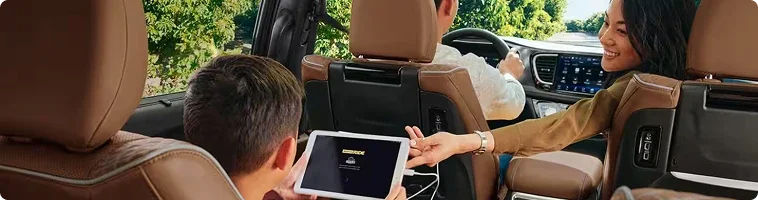
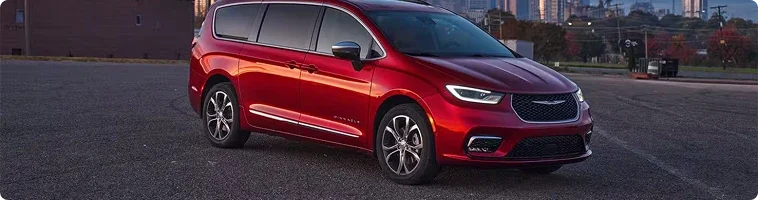
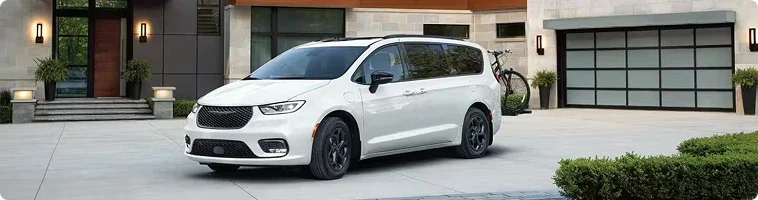
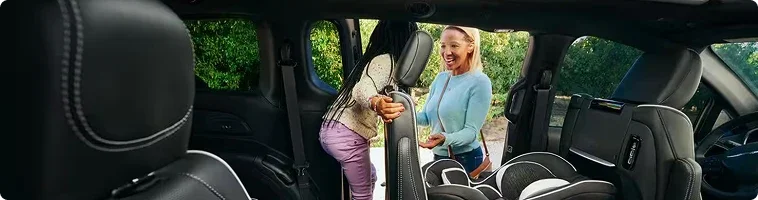
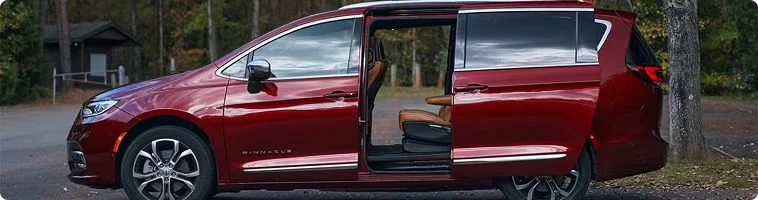
Behind the third row, these two vans are almost the same van. The 2026 Toyota Sienna measures 33.5 cubic feet back there
and the 2026 Chrysler Pacifica measures 32.3, a difference you would need a tape measure to notice. Measure from the
second row forward, though, and the two vans separate. The Pacifica carries 87.5 cubic feet behind its second row against
the Sienna's 75.2, and 140.5 cubic feet behind the front seats against 101. That is 12.3 cubic feet more on a normal
hauling day and 39.5 more when the van is loaded to the headliner.
At a Glance
Powertrain and Efficiency
Seating and Cargo
Choosing a Pacifica Trim
Size, Clearance and Towing
Driver Assistance
Technology and Audio
Safety
Warranty
Choose Which
FAQ
The Sienna answers with the fuel bill, and it answers hard. Toyota builds every Sienna as a hybrid, rated 36 mpg
combined with front-wheel drive against the Pacifica's 22, or 35 against 20 once you add all-wheel drive to each. That
is a 14 to 15 mpg gap on the window sticker, and nothing on the Pacifica's side of the ledger narrows it.
So the real question is which cost you would rather carry, and in Western Pennsylvania that usually turns on how the van
gets used. Put on serious annual mileage and the Pacifica's V-6 takes its cut every week at the pump, in a way you feel
by the end of the year. Use the van as the truck you never bought, and the Sienna's smaller cargo space costs you every
time you are down to two rows and the load still does not fit. Neither penalty shows up on a test drive. Both show up by
the third month.
At a Glance
By the time you are looking at these two side by side, the big questions are settled: sliding doors, a third row an
adult fits in, a back end that swallows a week of errands. This is where the two vans stop agreeing.
Dimension
2026 Chrysler Pacifica
2026 Toyota Sienna
Powertrain
3.6L Pentastar V-6
2.5L Dynamic Force four-cylinder hybrid
Trim levels offered
Select, Limited, Pinnacle
LE, XLE, XSE, Limited, Platinum, Woodland Edition
Drive systems offered
Front-wheel drive, or all-wheel drive on the Limited
Front-wheel drive, or Electronic On-Demand All-Wheel Drive
Fuel economy, front-wheel drive
19 city / 28 highway / 22 combined
36 city / 36 highway / 36 combined
Fuel economy, all-wheel drive
17 city / 25 highway / 20 combined
35 city / 36 highway / 35 combined
Cargo behind third / second / first row
32.3 / 87.5 / 140.5 cu ft
33.5 / 75.2 / 101 cu ft
Seating
7 standard; an 8-passenger layout is offered on the Select with front-wheel drive, and is not available with
all-wheel drive
7 or 8 depending on grade, including an 8-passenger LE with all-wheel drive
Maximum towing
3,600 lb when properly equipped, on the Limited and Pinnacle
3,500 lb on every grade
Main touchscreen
10.1 in
12.3 in
Government overall crash rating
5 stars
5 stars
Best-Fit Buyer Type
The family whose van hauls as often as it seats, and whose worst week is a cargo problem
The family that fills every belt, drives a lot of miles, and wants the fuel bill smaller
The split holds all the way down. Count the Sienna's biggest advantages per mile and per seat, and the Pacifica's in
cubic feet and in pounds on the hitch. (Toyota calls its trim levels grades, which is the same idea wearing a
different word.)
Powertrain and Efficiency
These two get a loaded van down the road in completely different ways, and the fuel numbers are the honest result of
that choice. The Pacifica uses a 3.6L Pentastar V-6 with a 948TE TorqueFlite nine-speed automatic and engine
stop-start. Every Sienna is a hybrid, pairing a 2.5L Dynamic Force four-cylinder with an electronically controlled
Continuously Variable Transmission.
Powertrain
2026 Chrysler Pacifica
2026 Toyota Sienna
Engine
3.6L Pentastar V-6
2.5L Dynamic Force four-cylinder
Rated output
287 hp at 6,400 rpm, the engine's own rating
245 hp, Toyota's rating for the whole hybrid system
Transmission
948TE TorqueFlite nine-speed automatic
Electronically controlled Continuously Variable Transmission with sequential shift mode
Fuel economy, front-wheel drive
19 / 28 / 22
36 / 36 / 36
Fuel economy, all-wheel drive
17 / 25 / 20
35 / 36 / 35
Fuel tank
19 gal
18 gal
Fuel grade
87-octane regular unleaded
87-octane regular unleaded
Those two horsepower figures are not counted the same way. Chrysler rates the Pentastar engine at 287 hp; Toyota rates
the whole hybrid system at 245 hp, engine and electric motor together. Both numbers are real, but they are not
measuring the same thing.
The Sienna's gasoline engine on its own is rated 189 hp at 6,000 rpm, and it works alongside an electric motor drawing
on a 288-volt nickel-metal hydride battery pack. The 245 hp is Toyota's rating for the two of them working together,
not the engine figure with a motor figure added to it.
The fuel gap is real and it is the Sienna's: 36 mpg combined against 22 with front-wheel drive, and 35 against 20 with
all-wheel drive. On 15,000 miles a year that is a difference a household notices every month. The Pacifica's fuel tank
holds 19 gallons against the Sienna's 18. One gallon does not answer the rating.
Seating and Cargo
This is where the Pacifica earns its keep, and it happens the moment you stop measuring from the third row. Both
vans hold roughly the same amount with all three rows in use. Measure with only two rows in use and they are nowhere
near equal.
Cargo volume
2026 Chrysler Pacifica
2026 Toyota Sienna
Difference
Behind the third row
32.3 cu ft
33.5 cu ft
1.2 cu ft to the Sienna
Behind the second row
87.5 cu ft
75.2 cu ft
12.3 cu ft to the Pacifica
Behind the first row
140.5 cu ft
101 cu ft
39.5 cu ft to the Pacifica
Take the three measurements in order. With everyone aboard, the Sienna is ahead by a grocery bag. Drop to two rows and
the Pacifica is ahead by about a full-size cooler plus the stroller you would otherwise have had to leave behind.
Empty the whole van and the two are not in the same class: 140.5 against 101 is one trip to the lumber yard instead of
two. If your van doubles as the truck you do not own, that last measurement is the one that matters.
Seat counts run the other way, and the catch is on the Pacifica's side.
Seating
2026 Chrysler Pacifica
2026 Toyota Sienna
Standard seat count
7, in a 2/2/3 layout
7 or 8, depending on grade
8-passenger availability
Offered on the Select with front-wheel drive; not available with all-wheel drive
Offered on the LE with front-wheel drive, the LE with all-wheel drive, and the XLE with front-wheel drive
A Pacifica cannot be ordered with 8 seats and all-wheel drive at the same time. The 8-passenger layout belongs to the
front-wheel-drive Select, and the Limited is the trim that carries all-wheel drive. A Sienna can do both: the LE is
sold as an 8-passenger van with all-wheel drive. So if the eighth belt is not negotiable and you want all-wheel drive
as well, the Sienna is the one van here that gives you both. Better to know that before you pick a trim than after.
Pacifica Interior Dimensions
Room in the Pacifica is a row-by-row question, and one number moves with the roof. Headroom depends on whether the
van has the dual-pane sunroof, so the front two rows carry two sets of figures.
Measure
First row
Second row
Third row
Headroom, without the dual-pane sunroof (Select)
40.1 in
39.6 in
38.7 in
Headroom, with the dual-pane sunroof (Limited and Pinnacle)
38.4 in
38.0 in
38.7 in
Legroom
41.1 in
39.0 in
36.5 in
Hip room
59.0 in
64.8 in
49.5 in
Seating volume
61.1 cu ft
56.5 cu ft
47.5 cu ft
The sunroof costs the front two rows a bit over an inch and a half of headroom, and the third row nothing at all.
That third row is the one most families are actually worried about. Below the knees, the third row has 3.5 inches of
knee clearance and the second row at least 4.8. The front seats slide 8.7 inches back and forth, which is what lets
a tall driver sit ahead of a rear-facing child seat.
Choosing a Pacifica Trim
Three trims, and the two decisions that pinch are both settled by which one you order. All-wheel drive lives on the
Limited. The eighth seat lives on the entry trim, front-wheel drive only. Everything else on the trim ladder is
comfort and equipment.
Select: the entry trim, with Caprice leatherette seating, a 6-speaker system and 17-inch wheels. It
is the only Pacifica that offers the 8-passenger layout, and the only one whose headroom figures are the taller pair,
because the dual-pane sunroof is not part of it.
Limited: the trim that can be ordered with all-wheel drive, and the comfort jump. It adds a dual-pane
sunroof, Nappa leather and ventilated front seats. A heated second row and a hands-free liftgate come with it, along
with an Alpine 13-speaker system, built-in navigation and 18-inch wheels.
Pinnacle: the top of the ladder. It brings quilted Nappa leather, second-row captain's chairs and
20-inch wheels. The audio steps up to a Harman Kardon 19-speaker system with a 10-inch subwoofer, and the camera to a
360-degree surround view with ParkSense front and rear park assist.
The ladder matters less than it seems to, because a good deal of the van is standard on all three:
Three-zone automatic climate control and remote start
Heated front seats and a heated leather-wrapped steering wheel
An 8-way power driver seat with memory
LED headlamps with automatic high beams, LED fog lamps and rain-sensing wipers
A 7-inch configurable instrument cluster and an auto-dimming rearview mirror
Grocery bag hooks on the third-row seatbacks
Size, Clearance and Towing
On the outside these are two vans of nearly identical size, and the differences are small enough to list in one
line: the Pacifica is 1.1 inches wider and rides on a wheelbase 1.1 inches longer, and the Sienna sits higher off
the ground.
Measure
2026 Chrysler Pacifica
2026 Toyota Sienna
Length
204.3 in
203.7 to 204.1 in
Width
79.6 in
78.5 in
Height
69.9 in front-wheel drive / 70.7 in all-wheel drive
4,610 lb on the LE to 4,725 lb on the Limited and Platinum
Maximum towing
3,600 lb when properly equipped, on the Limited and Pinnacle
3,500 lb on every grade, both drivetrains
Ground clearance is the Sienna's, by 1.2 inches against the front-wheel-drive Pacifica. On a rutted lane or an
unplowed lot, that extra inch and change is worth having.
Towing goes the other way, narrowly. The Pacifica is rated to tow 3,600 pounds when properly equipped, on the Limited
and Pinnacle. The Sienna is rated at 3,500 pounds on every grade Toyota sells, front-wheel drive or all-wheel drive.
That is 100 pounds, on 2 of the 3 Pacifica trims, and only with the right factory equipment. Call it a tiebreaker
rather than a headline. Either van will handle a small utility trailer, a pair of jet skis or a light popup camper.
Driver Assistance
Both vans arrive with a full set of driver aids as standard equipment. The difference is bookkeeping. Toyota gathers
its aids under one suite name, and Chrysler lists its own one by one, with no umbrella name over them, so the
columns read differently even where the hardware overlaps.
Driver assistance
2026 Chrysler Pacifica
2026 Toyota Sienna
Cruise, lane and braking aids
Adaptive Cruise Control with Stop and Go, Lane Departure Warning-Plus and pedestrian automatic emergency
braking, standard on every trim
Toyota Safety Sense 2.0, standard on every grade
Blind-spot coverage
Blind-spot Monitoring with Rear Cross Path detection, standard on every trim
Blind Spot Monitor with Rear Cross-Traffic Alert
Parking aids and cameras
ParkSense rear park assist with stop, standard on every trim; a ParkView rear backup camera on the Select and
Limited; a 360-degree surround view camera with ParkSense front and rear park assist, standard on the Pinnacle
Front and Rear Parking Assist with Automatic Braking, available
Where it counts on a minivan: a van spends its life in school lots and grocery-store parking lots, so the parking
hardware is worth more attention than the highway hardware. Both give you a camera and audible parking alerts, and the
Pacifica's top trim adds the overhead view that takes the guesswork out of a tight angled space. The Pacifica also
carries an electric parking brake with Safe Hold as standard equipment on all three trims.
Technology and Audio
Screen size is the Sienna's, and the top-end sound system is the Pacifica's, which is roughly how the two makers
have chosen to spend the money.
Technology
2026 Chrysler Pacifica
2026 Toyota Sienna
Main touchscreen
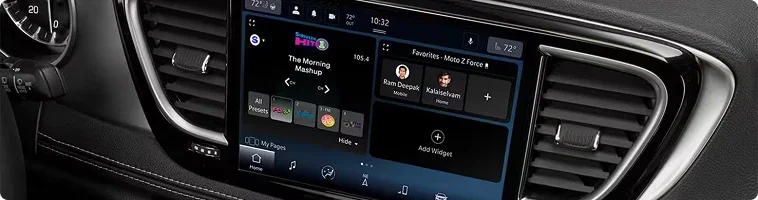
Uconnect 5 with a 10.1-inch touchscreen, standard on every trim
12.3-inch Toyota Audio Multimedia
Smartphone integration
Wireless Apple CarPlay and Android Auto
Wireless Apple CarPlay and Android Auto
Top audio system
Harman Kardon, 19 speakers with a 10-inch subwoofer, standard on the Pinnacle
JBL Premium Audio, 12 speakers, 1,200 watts, available
Neither of those is a reason to buy a minivan, but the audio gap is wider than the screen gap, and it lands on the
buyer who spends 5 hours in the van on a holiday drive rather than 20 minutes on a school run. The Pacifica also
carries SiriusXM 360L on all three trims.
Safety
The National Highway Traffic Safety Administration (NHTSA) rates the 2026 Chrysler Pacifica 5 stars overall, and the
2026 Toyota Sienna 5 stars overall as well. Nothing separates them on the headline result, so safety will not be what
settles this one, and the decision goes back to cargo and fuel. Ratings change as new tests are published, so check
NHTSA.gov for the latest.
Warranty
The two factory warranties are identical everywhere they overlap, and the Sienna adds coverage the Pacifica has no
equivalent of.
Coverage
2026 Chrysler Pacifica
2026 Toyota Sienna
Basic
36 months / 36,000 miles
36 months / 36,000 miles
Powertrain
60 months / 60,000 miles
60 months / 60,000 miles
Corrosion perforation
60 months / unlimited miles
60 months / unlimited miles
Hybrid system
None; the Pacifica is not a hybrid
96 months / 100,000 miles
Hybrid battery
None
120 months / 150,000 miles
The first three coverages match, so there is nothing to choose between them. The last two are the Sienna's, and they
matter to the buyer thinking about year 8 rather than year 3: they cover parts a hybrid has and a V-6 does not.
Choose Which
Choose the 2026 Chrysler Pacifica if your van is a hauler that happens to seat people. This is the
family that empties the back half of the van most weekends, and the household running one vehicle for both the school
run and the lumber run. It is the pick for anyone who would rather have the wider body and the bigger cargo space than
the smaller fuel bill, and for the buyer whose eighth passenger shows up occasionally rather than daily. If the
top-end audio matters to you, that is the reason to go all the way to the Pinnacle.
Choose the 2026 Toyota Sienna if the odometer moves fast and the seats stay full. If you have a long
commute, or a carpool that needs 8 belts and all-wheel drive in the same van, this is the one. Same answer if you plan
to keep the van long enough that the hybrid coverage is part of what you are buying, or you simply want more ground
clearance.
Where the Chrysler Pacifica Wins
The Pacifica's case starts with the two cargo measurements where it is ahead, and with what it can tow.
12.3 cubic feet more in the middle cargo measurement, at 87.5 against 75.2. This is the
configuration most vans spend their week in: front two rows in use, everything behind them carrying whatever the
day requires. That gap is where a second trip disappears.
39.5 cubic feet more behind the first row, at 140.5 against 101. Emptied out, the Pacifica is not
a little bigger. It is in a different bracket. A dorm room's worth of boxes, a job site's worth of materials, a
farmers-market haul: that is where it shows.
A higher maximum tow rating, at 3,600 pounds against 3,500: it comes with conditions, since it
takes the right factory equipment on 2 of the 3 trims. Inside those conditions, it is still the higher number.
A 19-speaker Harman Kardon system standard on the Pinnacle, against a 12-speaker system. On a
vehicle that carries a whole family on long drives, the top-end audio is not a trivial difference, and the
Pacifica's system is the deeper one.
Where the Toyota Sienna Wins
The Sienna's case starts at the pump and runs through the seating chart.
Fuel economy, by a wide margin: 36 mpg combined with front-wheel drive against 22, and 35 against
20 with all-wheel drive.
An 8-passenger layout you can have with all-wheel drive: the LE is sold that way, while the
Pacifica's 8-passenger layout is front-wheel drive only.
1.2 cubic feet more with all 3 rows in use, at 33.5 against 32.3, for the luggage carried with
every seat occupied.
A 12.3-inch touchscreen against 10.1 inches.
6.3 inches of ground clearance against 5.1, or 5.4 on an all-wheel-drive Pacifica.
Hybrid system coverage for 96 months or 100,000 miles and hybrid battery coverage for 120 months
or 150,000 miles, on top of a warranty otherwise identical to the Pacifica's.
How These Two Get Used Around Here
Vans in this valley get used harder than most families expect when they start shopping, and the cargo question
usually arrives second. Buyers start with seats, count the family, then remember the trailer that never got bought,
the plywood run, the summers of hauling kids and coolers up to Shenango River Lake and Pymatuning. That is usually
the moment 87.5 cubic feet against 75.2 turns from a number into a decision.
The honest way to settle it is to work out which penalty your household would actually pay. Around here the mileage
adds up: the valley is spread out, the drives are longer than they look, and a family running errands, practices and
a commute is not putting on city-car miles. That is the Sienna's argument, and on a gap of 14 to 15 mpg it is a
strong one.
But the same households are often the ones with a truck-shaped problem and no truck, and 39.5 cubic feet is not a
rounding error when the back is empty and the load still has to fit. One family pays at the pump. The other pays by
making a second trip. Decide which of those you would resent more and you have your answer.
We are the only Chrysler, Dodge, Jeep and Ram store in the Shenango Valley, so the Pacifica is a van we deliver,
service and keep seeing for years afterward. What we notice: families rarely regret buying too much room and often
regret buying too little, and the ones who put the fuel bill first are usually the ones driving the most miles. Both
instincts are right for the family that has them.
Winter is the other local factor. Cold, snowy months and salted roads are the normal case here, not the exception,
which is why the all-wheel-drive question gets asked on a minivan at all in Western Pennsylvania. Both of these vans
can be ordered with all-wheel drive, so traction is not what separates them. What differs is what you give up to get
it: on a Pacifica, all-wheel drive means the Limited, and it rules out the 8-passenger layout.
Pacifica offers do not sit still from one month to the next, so check our
new vehicle specials
page for what is current before you shop.
Load One Before You Decide
Cubic feet are hard to picture and easy to test. Bring the thing you actually haul, whether that is the hockey bag,
the double stroller or the folding tables, and put it in the back of a Pacifica before you sign anything. Sit in the
third row while you are here, because that is the seat someone in your family will be riding in for the next decade.
Bring whoever is tallest, so the headroom question gets answered by a person instead of a table.
Then drive a Sienna at a Toyota store, ideally the same afternoon on the same roads. We do not sell new Toyotas, so
we will not have a new Sienna on our lot, and setting up that second drive yourself is worth the hour. Two vans back
to back settle the cargo question faster than any comparison can.
When you are ready to look at specific vans, our
Chrysler Pacifica inventory
page lists what we have in stock with the figures for each one, and our
hours and directions
page has what you need to plan the visit.
Frequently Asked Questions
The Pacifica, once you get past the third row. With all 3 rows in use the Sienna holds 33.5 cubic feet and the
Pacifica 32.3. Behind the second row it is 87.5 cubic feet for the Pacifica against 75.2, and behind the front
seats 140.5 against 101. So the Sienna wins the smallest measurement by a little and the Pacifica wins the two
larger ones by a lot.
The 2026 Toyota Sienna holds 33.5 cubic feet behind its third row and the 2026 Chrysler Pacifica holds 32.3.
With every seat occupied, the two vans carry about the same amount of luggage.
Yes, and by a wide margin. Every Sienna is a hybrid and is rated 36 mpg combined with front-wheel drive, against
22 for the Pacifica. With all-wheel drive the figures are 35 for the Sienna and 20 for the Pacifica. If you
cover a lot of miles in a year, that gap is the strongest thing the Sienna has going for it.
Yes. All-wheel drive is offered on the Pacifica Limited. Choosing it changes two other things worth knowing:
fuel economy drops to 17 city / 25 highway / 20 combined, and the 8-passenger layout is not available with it.
The Sienna can and the Pacifica cannot. Toyota sells an LE with an 8-passenger layout and all-wheel drive. On
the Pacifica, the eighth seat is a Select option and front-wheel drive only, while all-wheel drive belongs to
the Limited, so the two cannot be combined.
The Pacifica's third row measures 38.7 inches of headroom, with or without the dual-pane sunroof. Legroom back
there is 36.5 inches, knee clearance is 3.5 inches, and the row's own seating volume is 47.5 cubic feet. It is
the one row in the van the sunroof does not shrink.
The Sienna. It has 6.3 inches of ground clearance, or 6.9 inches on the Woodland Edition, against 5.1 inches on
a front-wheel-drive Pacifica and 5.4 inches with all-wheel drive.
The Pacifica is rated to tow 3,600 pounds when properly equipped, on the Limited and Pinnacle. The Sienna is
rated at 3,500 pounds on every grade, with front-wheel drive or all-wheel drive. Either rating covers a small
utility trailer or a light popup camper. The figure that governs is the one on the exact van and equipment you
buy.
They are identical on basic, powertrain and corrosion coverage: 36 months or 36,000 miles, 60 months or 60,000
miles, and 60 months with unlimited miles respectively. The Sienna adds hybrid system coverage for 96 months or
100,000 miles and hybrid battery coverage for 120 months or 150,000 miles, which covers components the
Pacifica's V-6 does not have.
NHTSA rates the 2026 Chrysler Pacifica 5 stars overall and the 2026 Toyota Sienna 5 stars overall. Ratings
change as new tests are published, so check NHTSA.gov for the current figures.
The Sienna, at 12.3 inches against the Pacifica's 10.1-inch Uconnect 5 screen. Both support wireless Apple
CarPlay and Android Auto.
Start with the specific van, because trim, configuration and drivetrain all move the number. Once you have one
in mind, our
payment calculator
will estimate a monthly figure against a term and a down payment. Availability of any given trim and layout
varies through the year, so confirm the configuration before you build a payment around it.