2026 Jeep Grand Cherokee vs 2026 Ford Explorer: 5 Seats or 7
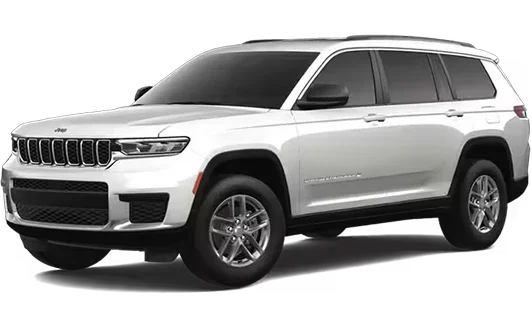
The 2026 Ford Explorer is a three-row SUV that seats 7. The 2026 Jeep Grand Cherokee is a two-row SUV that seats 5. Settle
that first, because it decides which Jeep you are shopping against the Explorer: the two-row Grand Cherokee, which
launched at $38,920, or the three-row Grand Cherokee L, which launched at $42,920 as a Laredo with 4x4. Inside the Jeep
line the third row costs you nothing at the hitch: both are rated to pull 6,200 pounds. Every price here is a
manufacturer's suggested retail price at launch for the 2026 model year, excluding the destination charge.
At a Glance
Powertrain
Fuel Economy
Towing and Clearance
Size, Seating and Cargo
Driver Assistance and Connectivity
Safety
Warranty
Price
Who Should Buy Which
FAQ
Beyond seat count, each of these SUVs has its own clear strengths, and they matter in Western Pennsylvania. The Grand
Cherokee is rated to tow 6,200 pounds against the Explorer's 5,000, clears 10.9 inches on its available air suspension
against the Explorer's best figure of 8.7, and carries the stronger turbocharged four-cylinder. The Explorer answers
with the stronger V6, better highway fuel economy from its turbocharged four, and more third-row leg and head room than
the Grand Cherokee L. The Jeep is built to pull, and its air suspension is built to climb. The Explorer is built to
carry 7 people down I-79, and on the highway its four-cylinder does it on less fuel.
At a Glance
Jeep answers the Explorer's third row with a separate model rather than a bigger back seat, so the comparison runs
across three vehicles rather than two.
Dimension
2026 Jeep Grand Cherokee
2026 Jeep Grand Cherokee L
2026 Ford Explorer
Rows and seats
2 rows, up to 5
3 rows, up to 7
3 rows, 7, or 6 on the Tremor with second-row captain's chairs
MSRP at launch
$38,920 starting
$42,920 (Laredo, 4x4)
$38,465 to $54,905 across 5 grades
Maximum trailer weight, properly equipped
6,200 lb
6,200 lb
5,000 lb with the trailer tow package
Turbocharged four-cylinder
324 hp, 332 lb-ft
324 hp, 332 lb-ft
300 hp, 310 lb-ft
V6
293 hp, 257 lb-ft
293 hp, 257 lb-ft
385 hp, 415 lb-ft on premium fuel
Transmission
8-speed automatic
8-speed automatic
10-speed automatic
Drive configurations
Rear-wheel drive and 4x4
Rear-wheel drive and 4x4
Rear-wheel drive, with available Intelligent 4WD
Ground clearance
8.4 in, or 10.9 in with the available air suspension
8.5 in, or 10.9 in with air suspension
7.6 in on the Active to 8.7 in on the Tremor
Overall length
193.5 in
204.9 in
198.7 in
Cargo behind the last row of seats
37.7 cu ft behind the second row
17.2 cu ft behind the third row
16.3 cu ft behind the third row
Cargo behind the front row
70.8 cu ft
84.6 cu ft
85.8 cu ft
Total passenger volume
144.6 cu ft
159.1 cu ft
150.3 cu ft
Fuel tank
23 gal
23 gal
18.6 gal with the 2.3L EcoBoost, 20.2 gal with the V6
NHTSA overall rating
5 stars
5 stars
5 stars
Best-Fit Buyer Type
The 5-seat household that tows, drives unplowed hills, or wants the air suspension's clearance and will not pay
for seats nobody sits in
The 7-seat household that refuses to give up the 6,200-pound tow rating to get its third row
The 7-seat family that puts highway fuel economy and third-row room ahead of towing margin and clearance
MSRP at launch for the 2026 model year, excluding the destination charge. The Grand Cherokee figure is where its line
starts; the Grand Cherokee L figure is the Laredo trim with 4x4; the Explorer figure is an entry price and a span
across its 5 grades.
Two lines in that table carry most of the decision. Seating is the first: two rows on one Jeep, three on the other.
Towing explains why Jeep's three-row answer is still a Jeep answer, since the L pulls the same 6,200 pounds as its
shorter sibling.
The rest falls into a pattern. Where a number describes pulling, tank size, or the air suspension's clearance, the
Jeeps lead and the row count changes nothing. Where it describes people and highway miles, the Explorer and the Grand
Cherokee L trade places measurement by measurement, and the five-seat Jeep is not in that argument at all.
Powertrain
Each of these SUVs offers a turbocharged four-cylinder and a V6, and the winner flips depending on which pair you
line up.
Powertrain
Jeep Grand Cherokee and Grand Cherokee L
Ford Explorer
Turbocharged four-cylinder
2.0L Hurricane 4 Turbo, 324 hp at 6,000 rpm, 332 lb-ft at 3,000 to 4,500 rpm
2.3L EcoBoost I-4, 300 hp at 5,500 rpm, 310 lb-ft at 3,500 rpm
V6
3.6L V6, 293 hp at 6,400 rpm, 257 lb-ft at 4,000 rpm
3.0L EcoBoost V6, 385 hp at 5,500 rpm, 415 lb-ft at 3,500 rpm on premium fuel
Transmission
8-speed automatic
10-speed automatic
Drive configurations
Rear-wheel drive and 4x4
Rear-wheel drive, with available Intelligent 4WD
Compare four-cylinder to four-cylinder and the Jeep leads by 24 horsepower and 22 lb-ft. Compare V6 to V6 and the
Explorer leads by 92 horsepower and 158 lb-ft, on premium fuel. Both are true at once, so the engine question does not
settle this matchup by itself. The four-cylinders are close. The V6s are not.
Two details ride along with those figures. The Explorer's 385 horsepower comes on premium fuel, while its EPA ratings
are set on regular unleaded, so its strongest engine gets measured on two different grades of gasoline depending on
which figure you are reading. And the Jeeps run an 8-speed automatic where the Explorer runs a 10-speed, which changes
how each one delivers what it makes. Gear spacing is something you feel from the driver's seat.
Fuel Economy
On the highway the Explorer's turbocharged four is the more efficient engine. Line the V6s up in rear drive and the
Grand Cherokee takes the mileage back.
EPA rating
Jeep Grand Cherokee
Jeep Grand Cherokee L
Ford Explorer
Turbocharged four, rear-wheel drive
21 / 27 / 23
21 / 26 / 23
20 / 29 / 24
Turbocharged four, four-wheel drive
20 / 25 / 22
20 / 25 / 22
20 / 27 / 23
V6, rear-wheel drive
19 / 26 / 22
19 / 26 / 21
18 / 25 / 21
EPA city / highway / combined ratings on regular unleaded.
With the turbocharged fours: in rear-wheel drive the Explorer is rated 29 highway and 24 combined, against 27 and 23
for the Grand Cherokee and 26 and 23 for the Grand Cherokee L. Both Jeeps lead the city column, though, at 21 against
the Explorer's 20. In four-wheel drive all three sit at 20 in the city, and the Explorer holds a 2 mpg highway edge
and 1 combined.
With the V6s and rear drive: the two-row Grand Cherokee takes back 1 mpg in every column.
Between the two Jeeps: with the turbocharged four the L gives up nothing in four-wheel drive, and 1 mpg on the highway
in rear drive. That is the fuel-economy price of the third row on that engine, and it is close to nothing.
None of these gaps is big enough to decide a purchase by itself. Seating and towing carry more weight than any of
these figures. Most winter buyers around here end up in four-wheel drive, so those are the numbers to read twice.
Towing, Clearance and Off-Road Geometry
Towing is the Grand Cherokee's clearest advantage in this matchup, and adding a third row takes nothing away from
it.
Capability
Jeep Grand Cherokee
Jeep Grand Cherokee L
Ford Explorer
Maximum trailer weight, properly equipped
6,200 lb
6,200 lb
5,000 lb with the trailer tow package
Ground clearance
8.4 in standard, 10.9 in with the available air suspension
8.5 in standard, 10.9 in with air suspension
7.6 in on the Active, 7.8 in on the ST, 8.3 in on the Platinum, 8.7 in on the Tremor
Approach angle, standard suspension
20.5 deg
20.6 deg
19.7 deg, or 24.1 deg on the Tremor
Breakover angle, standard suspension
19.1 deg
18.2 deg
16.5 deg, or 18.7 deg on the Tremor
Departure angle, standard suspension
26.6 deg
21.5 deg
21.5 deg, or 23.7 deg on the Tremor
Fuel tank
23 gal
23 gal
18.6 gal with the 2.3L EcoBoost, 20.2 gal with the V6
Four of those lines need reading rather than scanning.
The towing margin: 1,200 pounds, and it is the same on both Jeeps, so a shopper who needs 7 seats and
a 6,000-pound trailer never has to choose between the third row and the rating.
Clearance without the air suspension: Ford measures the Explorer's figure as minimum running ground
clearance, and the Jeeps' 8.4 and 8.5 inches on standard suspension sit between the Explorer's Active at 7.6 and its
Tremor at 8.7. Nobody wins this one.
Clearance with air suspension: 10.9 inches against the Explorer's best figure of 8.7 is a 2.2-inch
gap, too wide for the difference in how each maker measures to explain.
The angles: against the base Explorer the two-row Jeep leads all three, and departure is where it
pulls away, at 26.6 degrees. The Tremor is the exception at the front: its 24.1-degree approach angle is the steepest
single figure in the group, the Explorer's answer at the front bumper rather than the rear.
Tank size is a towing fact as much as an economy one. A trailer drags a combined rating down, and the Jeeps start with
23 gallons under them.
Size, Seating and Cargo
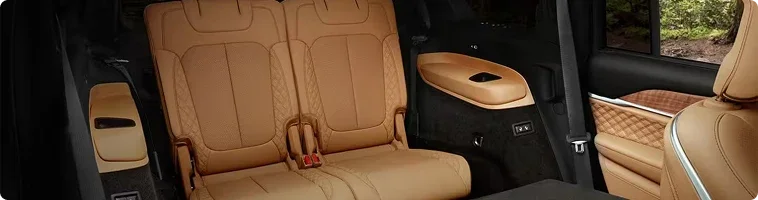
Row count decides more here than any other number. The shorter Grand Cherokee seats 5 and has no third row at all,
so the Grand Cherokee L is the Jeep to hold against the Explorer on seating and back-row space.
Exterior dimension
Jeep Grand Cherokee
Jeep Grand Cherokee L
Ford Explorer
Overall length
193.5 in
204.9 in
198.7 in
Wheelbase
116.7 in
121.7 in
119.1 in
Body width, mirrors excluded
77.5 in
77.5 in
78.9 in
Overall height
70.8 in on standard suspension
71.5 in
69.6 in
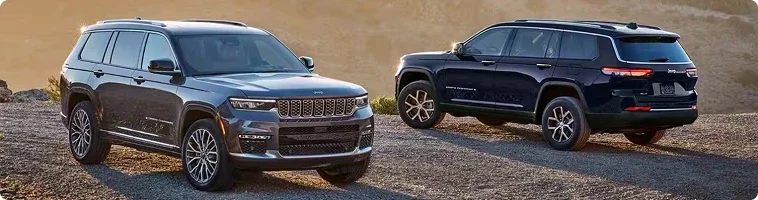
The five-seat Grand Cherokee is 5.2 inches shorter than the Explorer, and the L is 6.2 inches longer. Parked side by
side, the L is the longest of the three and the two-row the shortest. The wheelbase line tells the same story from
underneath: the L stretches 121.7 inches between the axles, the Explorer 119.1, the two-row 116.7. Inside, the same
three-way split holds.
Interior space
Jeep Grand Cherokee
Jeep Grand Cherokee L
Ford Explorer
Rows and seats
2 rows, up to 5
3 rows, up to 7
3 rows, 7, or 6 on the Tremor
Total passenger volume
144.6 cu ft
159.1 cu ft
150.3 cu ft
Cargo behind the third row
No third row
17.2 cu ft
16.3 cu ft
Cargo behind the second row
37.7 cu ft
46.9 cu ft
46.0 cu ft
Cargo behind the front row
70.8 cu ft
84.6 cu ft
85.8 cu ft
Head room, front / second / third
39.9 / 39.4 in
39.8 / 39.9 / 37.3 in
40.7 / 40.5 / 38.9 in
Leg room, front / second / third
41.3 / 38.2 in
41.3 / 39.4 / 30.3 in
43.0 / 37.5 / 31.8 in
Shoulder room, front / second / third
59.2 / 58 in
59.2 / 58 / 51.9 in
62.1 / 61.9 / 54.6 in
Hip room, front / second / third
57.4 / 56.3 in
57.4 / 56.3 / 42.9 in
59.2 / 59.1 / 40.9 in
The two-row Grand Cherokee has no third row, so its interior-room figures list the front and second rows only. Its
second-row measurements are the back seat, not a middle one.
Some of the Explorer's own figures move from one grade, or trim level, to the next, so check which grade you are
looking at before you hold it against a Grand Cherokee L.
Explorer figure
Base figure
Where it changes by grade
Total passenger volume
150.3 cu ft
149.5 cu ft on the ST and Tremor, 143.8 cu ft on the Platinum
Cargo behind the front row
85.8 cu ft
85.3 cu ft on the ST, Platinum and Tremor
Head room, front / second
40.7 / 40.5 in
38.9 / 38.2 in on the Platinum
Leg room, front / second
43.0 / 37.5 in
42.9 / 37.0 in on the ST, Platinum and Tremor
Overall height
69.6 in
69.8 in on the ST, 70.2 in on the Platinum, 70.8 in on the Tremor
The Platinum is the grade that moves most: 143.8 cubic feet of passenger volume against the base 150.3, and the lowest
head room of any Explorer figure here. That matters if the Platinum is the Explorer on your shortlist.
Read the cargo lines carefully, because the shape of the vehicle is doing some of the talking. The Explorer's 46.0
cubic feet behind the second row has a folded third row underneath it, while the shorter Grand Cherokee's 37.7 cubic
feet is the entire back of a five-seat SUV with no seats stowed anywhere. Held three rows against three, the Grand
Cherokee L and the Explorer land within about a cubic foot of each other at all three cargo measurements. The L holds
0.9 cubic foot more behind the third row and 0.9 more behind the second; the Explorer holds 1.2 cubic feet more behind
the front row. Those are real numbers and small ones.
Third-row room is a clearer trade. The Explorer gives its back-seat passengers 1.5 inches more leg room and 1.6 inches
more head room than the Grand Cherokee L, while the L returns 2.0 inches more hip room. The Explorer is also the wider
cabin in the first two rows, at 62.1 and 61.9 inches of shoulder room against 59.2 and 58. The L's counter is total
volume: 159.1 cubic feet against 150.3, an 8.8-cubic-foot difference spread across the cabin.
One thing for anyone still weighing the five-seat Jeep against a three-row vehicle: its 144.6 cubic feet of passenger
volume and 37.7 behind the second row are five-seat numbers, and no configuration of the Grand Cherokee seats more
than 5. If a third row is why you are shopping, the two-row is the wrong Jeep and the L is the right one.
Driver Assistance and Connectivity
Both SUVs bundle their driver-assistance features under a brand name, and both offer a hands-free highway system.
Feature
Jeep Grand Cherokee and Grand Cherokee L
Ford Explorer
Driver-assistance suite
Active Driving Assist System
Ford Co-Pilot360
Hands-free highway driving
Available Hands-Free Active Driving Assist
Available BlueCruise
Phone mirroring
Wireless Apple CarPlay support and wireless Android Auto compatibility
Wireless Apple CarPlay and Android Auto
Available premium audio
McIntosh High-Performance Audio
Bang & Olufsen
Hands-free driving is an available system on both, not something every example carries, so check it on the specific
vehicle in front of you. Same with the audio: McIntosh on the Jeep side and Bang & Olufsen on the Ford side are
both available systems rather than standard equipment. Phone mirroring is the one clean tie here, since both run Apple
CarPlay and Android Auto without a cable.
Safety
NHTSA, the National Highway Traffic Safety Administration, rates the 2026 Jeep Grand Cherokee 5 stars overall, the
2026 Jeep Grand Cherokee L 5 stars overall, and the 2026 Ford Explorer 5 stars overall. On the federal overall score
there is nothing to separate these three, which is worth knowing before you spend a weekend hunting for a safety gap
that is not there. That overall star is a single rolled-up score, so if crash performance is the number your household
decides on, read the individual test results behind it rather than the headline. Ratings change as new tests are
published, so check NHTSA.gov for the latest.
Warranty
Coverage is a genuine tie, term for term. Both Jeeps carry identical warranty terms, so the comparison runs Jeep
against Ford rather than model against model.
Coverage
Jeep Grand Cherokee and Grand Cherokee L
Ford Explorer
Basic
36 months / 36,000 miles
36 months / 36,000 miles, bumper to bumper
Powertrain
60 months / 60,000 miles
60 months / 60,000 miles
Corrosion perforation
60 months / unlimited miles
60 months / unlimited miles
Roadside assistance
60 months / 60,000 miles
60 months / 60,000 miles, a separate complimentary program rather than warranty coverage
Four lines, four matches. The only difference is in how the last one is structured: Ford runs its roadside coverage as
a separate complimentary program rather than as warranty coverage, on the same 60-month, 60,000-mile terms. If
warranty length is on your comparison sheet, cross it off and spend your attention on towing, seats, and fuel.
Price
The Grand Cherokee L figure below is a Laredo with 4x4. The two-row figure is where the Grand Cherokee line starts.
Vehicle and configuration
MSRP at Launch
2026 Jeep Grand Cherokee, two-row, starting
$38,920
2026 Jeep Grand Cherokee L, Laredo, 4x4, three-row
$42,920
2026 Ford Explorer, across 5 grades
$38,465 to $54,905
MSRP at launch for the 2026 model year, excluding the destination charge.
The two Jeep figures sit on different footings: one is where the line starts, the other is a specific Laredo with 4x4.
Ask us to price the exact configurations you are weighing side by side, because that is the number your budget
actually turns on. The Explorer figure is an entry price plus a span across 5 grades, not one configuration, so it
answers a different question.
Both Jeeps share one trim ladder, and both figures above are the Laredo with 4x4. How far up that ladder you go is a
decision you make after the row count, not instead of it.
What a Grand Cherokee actually sells for on a given day is a separate matter from MSRP, and the listings carry it. See
2026 Grand Cherokee inventory
for what is on the ground now, or estimate a monthly figure with our
payment calculator. Our Jeep specials change monthly, so see our
new vehicle specials
for the latest deals.
Who Should Buy Which
Three vehicles, three answers, and seat count settles most of it before any other number gets a vote.
Choose the 2026 Jeep Grand Cherokee if you need 5 seats or fewer, you tow anything approaching 6,000
pounds, you want the air suspension's 10.9 inches of clearance for unplowed mornings, or you want the stronger
turbocharged four and the 23-gallon tank. Skipping the third row also puts 193.5 inches in your garage instead of
204.9.
Choose the 2026 Jeep Grand Cherokee L if you need 7 seats and refuse to give up the 6,200-pound tow
rating or the air suspension's 10.9 inches of clearance to get them. It is the same vehicle in the ways that matter to
a trailer. It is also 204.9 inches long against the two-row's 193.5.
Choose the 2026 Ford Explorer if the back row is where people actually sit, and its leg and head room
matter more to you than tow rating or clearance. It also holds the strongest V6 in the group, and its turbocharged
four is the better highway engine, which is a difference you notice every week.
Where the Jeep Grand Cherokee Wins
Towing: 6,200 pounds properly equipped against 5,000 pounds with the trailer tow package. That is
1,200 pounds of margin, and it is identical on the two-row Grand Cherokee and the three-row L.
Clearance with air suspension: 10.9 inches against the highest figure on any Explorer, 8.7 inches
on the Tremor, a 2.2-inch difference.
Off-road geometry on standard suspension, against the base Explorer: 20.5 degrees approach, 19.1
breakover and 26.6 departure against 19.7, 16.5 and 21.5.
The turbocharged four: 324 horsepower and 332 lb-ft against 300 and 310.
V6 fuel economy with rear drive: the two-row's 19 / 26 / 22 against 18 / 25 / 21, a mile per
gallon in all three columns.
Fuel tank: 23 gallons against 18.6 or 20.2, which is 2.8 to 4.4 gallons more between fills.
Passenger volume, three rows against three: the Grand Cherokee L's 159.1 cubic feet against
150.3, plus 0.9 cubic foot more behind the third row and 0.9 more behind the second.
Where the Ford Explorer Wins
The V6: 385 horsepower and 415 lb-ft on premium fuel, against 293 and 257.
Highway fuel economy with the turbocharged four: 29 mpg highway and 24 combined with rear drive,
against 27 and 23 for the Grand Cherokee and 26 and 23 for the Grand Cherokee L. With four-wheel drive it is 27
and 23 against both Jeeps' 25 and 22, all three level at 20 in the city.
Third-row room: 31.8 inches of leg room and 38.9 inches of head room, against the Grand Cherokee
L's 30.3 and 37.3.
Cabin width in the first two rows: 62.1 and 61.9 inches of shoulder room, against 59.2 and 58.
Cargo behind the front row: 85.8 cubic feet against the L's 84.6.
The Tremor's approach angle: 24.1 degrees, the steepest single figure in this comparison.
Winter, Towing and Third Rows in the Shenango Valley
No other Chrysler, Dodge, Jeep and Ram dealership sits in the Shenango Valley. Most of the Grand Cherokee shopping
around here comes through our lot on North Hermitage Road, and the same two questions arrive every winter.
Whether the clearance and the 4x4 are worth paying for: January averages around 27 degrees in Sharon, the valley
roads get salted heavily, and the hills off East State Street and out toward Shenango River Lake do not wait for the
plow. Shoppers coming in from Sharon, Farrell and Sharpsville are on those roads twice a day, and the ones driving
in from Greenville or New Wilmington add county two-lanes and the Shenango Valley Freeway to the trip. That is what
the air suspension's 10.9 inches and a 4x4 configuration are actually for around here.
Whether the third row is worth the money: that one usually arrives as a budget question rather than a seating
question. A household that needs 7 seats and a tow rating is looking at a $42,920 vehicle before the destination
charge, which is the point where a certified used example stops being a consolation and becomes a real third option.
Our
Certified Pre-Owned Program
covers CPO Base vehicles from the 2020 through 2025 model years under 75,000 miles with a 7-year, 100,000-mile
powertrain limited warranty from the original sale date, plus 3 months or 3,000 miles of Maximum Care coverage. If a
used Grand Cherokee L can do everything on your list, it does it for less.
In this valley the decision is less Jeep against Ford than 5 seats against 7. If the back row carries groceries and
a dog, the two-row Grand Cherokee is the shorter Jeep and the less expensive one, and it tows the same 6,200 pounds.
Its 193.5 inches also fits an older valley garage that 204.9 might not.
If people ride back there every week, the shortlist narrows to the Grand Cherokee L and the Explorer. Then it is one
trade: 1,200 pounds of trailer rating and the air suspension's clearance, against 1.5 inches of third-row leg room
and 2 mpg of highway economy when both run their turbocharged fours in four-wheel drive. Youngstown and Warren sit
about 15 miles west, close enough that an Ohio shopper can settle the Jeep half of that question on a short drive
east.
A new Explorer is not something we will have on our lot, since we do not sell new Fords. That is not a reason to
skip it: drive one at a Ford dealership, then come drive the Jeep, and let the two answer for themselves.
Driving One Before You Buy
Ten minutes in a third row settles more than any seat-count or cargo figure. Sit in the Grand Cherokee L's back row
with the second-row seat where you would actually leave it, then do the same in an Explorer at a Ford store, and the
1.5-inch leg-room difference stops being abstract.
Run the same test in the shorter Grand Cherokee's second row, which is its back seat rather than its middle one, and
you will know within a minute whether 5 seats is enough for your household. If towing is the reason you are here,
bring what the trailer weighs loaded rather than empty, and we will check it against what the exact Jeep you are
looking at is rated to pull.
No. The Grand Cherokee is a two-row SUV with seating for up to 5. The third-row Jeep is the Grand Cherokee L,
which seats up to 7 and is a separate model with its own price.
The Grand Cherokee L. It seats up to 7, the same as the Explorer, and it is the vehicle to compare when a third
row is why you are shopping at all. Its shorter sibling is cheaper and easier to park, but it works only if 5
seats is enough.
The five-seat Grand Cherokee launched at $38,920 and the Grand Cherokee L launched at $42,920 as a Laredo with
4x4, both excluding the destination charge. Those two figures sit on different footings, so ask us to price the
exact configurations you are choosing between.
The Grand Cherokee, by 1,200 pounds. Its maximum trailer weight is 6,200 pounds properly equipped, against 5,000
pounds for the Explorer with the trailer tow package.
Yes. Both carry a 6,200-pound maximum trailer weight when properly equipped, so the extra row costs you nothing
at the hitch.
The Grand Cherokee L, at 17.2 cubic feet against 16.3. The margin is 0.9 cubic foot, which is close enough that
a stroller will decide it rather than the spec.
The two-row Grand Cherokee carries 37.7 cubic feet of cargo behind its second row and 70.8 behind the front row.
Both are five-seat figures with no third row folded underneath them, which is why they read lower than a
three-row SUV's numbers at the same measurement points.
It depends on the engine and the drivetrain. With the turbocharged fours in four-wheel drive all three sit at 20
in the city, and the Explorer takes 27 highway and 23 combined against both Jeeps' 25 and 22. In rear-wheel
drive the Explorer is rated 29 and 24, against the Grand Cherokee's 27 and 23 and the Grand Cherokee L's 26 and
23, while both Jeeps lead the city column at 21 against 20. With the V6s and rear drive the two-row Jeep takes
back 1 mpg in every column.
The Explorer's 3.0L EcoBoost V6, at 385 horsepower and 415 lb-ft on premium fuel. Among the turbocharged
four-cylinders the Grand Cherokee's 2.0L Hurricane 4 Turbo leads, at 324 horsepower and 332 lb-ft against 300
and 310.
The available air suspension. Standard suspension puts the Grand Cherokee at 8.4 inches and the Grand Cherokee L
at 8.5, both of which land between the Explorer's 7.6 inches on the Active and 8.7 on the Tremor.
NHTSA rates all three 5 stars overall, the two Jeeps and the Explorer alike. Ratings change as new tests are
published, so check NHTSA.gov for the latest.
Both Jeeps, yes: we sell the two-row Grand Cherokee and the three-row L. We do not sell new Fords, so a new
Explorer is not something we will have on our lot; drive that one at a Ford store and put the two back to back.
Schedule a test drive
for the Jeep side.
The listings answer that faster than any page can, and they change daily. Check
Jeep Grand Cherokee inventory
for the two-row and L examples on the ground right now.